
Edible bird’s nest, or 燕窝 (yàn wo), is one of the most expensive Asian food delicacies today, retailing for about S$5,000 per kg. It has been prescribed in traditional Chinese medicine for over a thousand years, and forms a multi-billion dollar annual trade. It is usually white in colour, but there also exists a red version, called “blood nest” (血燕, xuĕ yàn), which is significantly more expensive and believed to have more medicinal value. The reason for the red colour has been a puzzle for centuries. Contrary to popular beliefs, red bird’s nest does not contain haemoglobin, the protein responsible for the red colour in blood.
The colouration of red bird’s nest has now been explained by Professor Lee Soo Ying, a chemist at NTU’s School of Physical and Mathematical Sciences, and his PhD student Eric Shim. In a May 2018 paper in the Journal of Agricultural and Food Chemistry, published by the American Chemical Society, the researchers report that the red colour is caused by the vapour of reactive nitrogen species, in the atmosphere of the bird house or cave, reacting with the initially formed white bird nest.
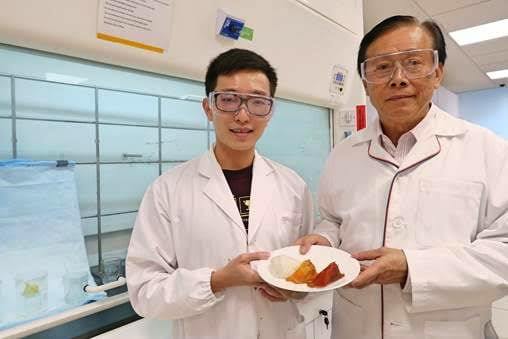
Professor Lee Soo Ying and Eric Shim, with samples of white and coloured bird’s nests. Credit: Janis Zhang.
The researchers also note that the bird nest also absorbs nitrite and nitrate, which are potentially carcinogenic (cancer-causing), from the vapour. This may mean that non-white bird’s nest is harmful to human health.
Edible bird’s nest consists mainly of a substance called glycoprotein. By performing biochemical and spectroscopic analysis on white and red bird’s nest, Professor Lee and his student pinpointed the key role played by tyrosine, an amino acid in the glycoprotein. Red bird’s nest contains tyrosine that has combined with reactive nitrogen species to form a new molecule called 3-Nitrotyrosine. At high concentrations, this molecule produces a rich red colour, while at lower concentrations, it produces the yellow, golden and orange colours seen in other varieties of bird’s nest products.
As Professor Lee explains, the vapour of reactive nitrogen species producing this chemical reaction originates from bird droppings. “Red nests, and generally coloured nests, are produced in poorly-maintained bird houses where there is much bird faeces on the floor,” he says. “The swiftlet feeds on tiny flying insects, and so the bird faeces are protein or nitrogen rich. Bacteria decomposes the bird faeces to produce a vapour of reactive nitrogen species, which rises from the floor and reacts with the tyrosine in the bird’s nest above.”
With this research, the puzzle of the colour of red bird’s nest has been solved, albeit in a manner most did not expect. The research also explains why the red bird’s nest contains a high concentration of nitrite and nitrate which are known to lead to carcinogenic compounds. Conversely, white bird’s nest has the capacity to mop up reactive nitrogen species which is generated when our body has disease-related nitrative stress such as in chronic inflammation, atherosclerosis etc. This could be one of the benefits of consuming white bird’s nest, amongst other possible benefits.
Reference: