
Functional Polymers: From New Synthetic Routes To Applications In Energy Storage
Abstract
Functional polymers are based on certain chemical functional groups. As such, the inspiration from organic chemistry has always been fruitful to the development of new synthetic routes to functional polymers. Further, the thrive for structure-property relationships in polymer materials requires a precise control of polymer structures. As such, different aspects will be discussed:
Post-polymerization modifications (PPMs) have been a valuable synthetic route for the preparation of functional polymers since the early beginnings of polymer science. Over the decades, new and highly efficient routes have been described, taking advantage of reactive monomers. In conjunction with the advent of reversible-deactivation radical polymerizations (RDRPs), PPMs have proven to be extremely powerful in the synthesis of libraries of functional polymers to study structure-property relationships. In this presentation, we will look back to past routes and forward to new routes that render PPMs as continuously valuable synthetic tools in polymer science as an interdisciplinary science. Functional polymers are based on certain chemical functional groups. As such, the inspiration from organic chemistry has always been fruitful to the development of new synthetic routes to functional polymers via PPMs. Examples that showcase the introduction of highly functional groups as well as the complete removal of functional groups will be discussed.
Poly(ethylene oxide) PEO is a readily investigated polymer in numerous applications. One of them being its utilization as an electrolyte for solid-state batteries. However, not much is known on structural variants of PEO about the utilization as polymer electrolytes. Herein, we present the synthesis of some novel PEO-based polymer architectures and their utilization as polymer electrolytes.
Sulfur and particular functional groups derived from sulfur have been major players in this area of exciting research and further have been utilized for the design and preparation of polymeric materials that lead to a plethora of applications. A strategy to convert sulfur into polymeric materials is the inverse vulcanization reaction of sulfur with alkenes. However, the materials formed are of limited applicability, because they need to be cured at high temperatures (>130 °C) for many hours. Herein, we discuss the reaction of elemental sulfur with vinyl alkoxysilanes to enable a control of materials properties. Also, post-polymerization modifications of such inverse vulcanized polymers will be discussed.
Host: Prof. Atsushi Goto and Prof. Duan Hongwei
Biography
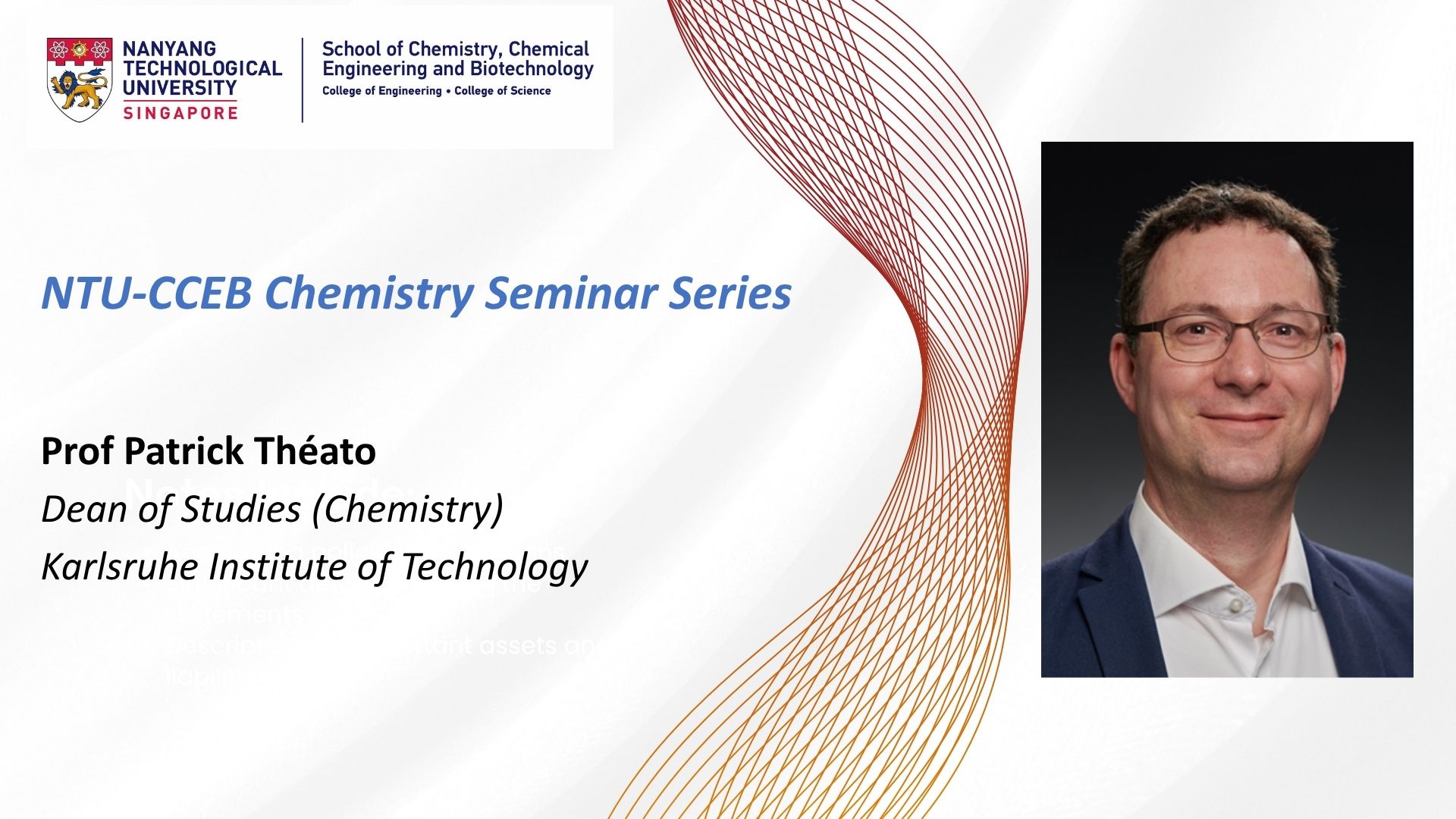
Professor Patrick Théato is a leading expert in polymer science and has been a Full Professor at the Karlsruhe Institute of Technology (KIT), Germany, since 2017. He earned his PhD in Chemistry from Johannes Gutenberg University Mainz in 2001 and has held academic positions worldwide, including at Seoul National University, the University of Sheffield, and the University of Hamburg.
His research focuses on developing functional polymers through innovative synthetic strategies, especially post-polymerization modifications. His work has broad applications in materials science, biomedical engineering, nanotechnology, and energy storage.
In addition to his research, Professor Théato actively contributes to the scientific community as Dean of Studies (Chemistry) at KIT, Chair of the IUPAC Subcommittee on Polymer Terminology, and since 2024, Associate Editor of Polymer Science & Technology. He also serves on editorial boards of several leading journals