
Bridging Physics-Informed and Data-Driven Materials Designs to Catalyze Deep Decarbonization
Abstract
Electrifying and decarbonizing key industrial sectors, including chemical and materials industries, as well as transportation and aviation, is a pressing mission of our time. Industrial players and governments worldwide have set ambitious targets to reduce carbon emissions, which need to be decreased to net-zero around mid-century in order to address global warming and climate change. For such deep decarbonization, it is crucial to develop unprecedented materials, such as electrocatalysts that can efficiently and steadily produce green chemicals and fuels at scale and generate renewable electricity on demand. In this seminar, I will introduce how a joint computational–experimental approach can be established to accelerate catalyst materials design using first-principles atomistic simulations, synchrotron X-ray spectroscopies, and physics-inspired machine learning. I will highlight how mechanistically elucidating and quantitatively controlling the electronic structure of transition metal compounds can effectively alter their chemical bondings, modulate key reaction barriers toward dissolution and electrocatalysis, and thus influence their durability and reactivity, respectively, offering physics-driven guiding principles for optimizing their catalytic performance. Moreover, I will demonstrate how combining machine learning with materials physics can accelerate the discovery of multicomponent oxides—a new class of materials with too-complicated atomic orderings for an exhaustive investigation—through the development of machine-learning models that accurately predict ordering-dependent materials properties by capturing intrinsic symmetries. To conclude, I will discuss new opportunities for further resolving fundamental knowledge gaps between the structural, reaction, and compositional complexities of electrocatalyst surfaces to fully unlock transformative materials design for catalyzing sustainability and decarbonization.
Host: Assistant Prof. Nitish Govindarajan
Biography
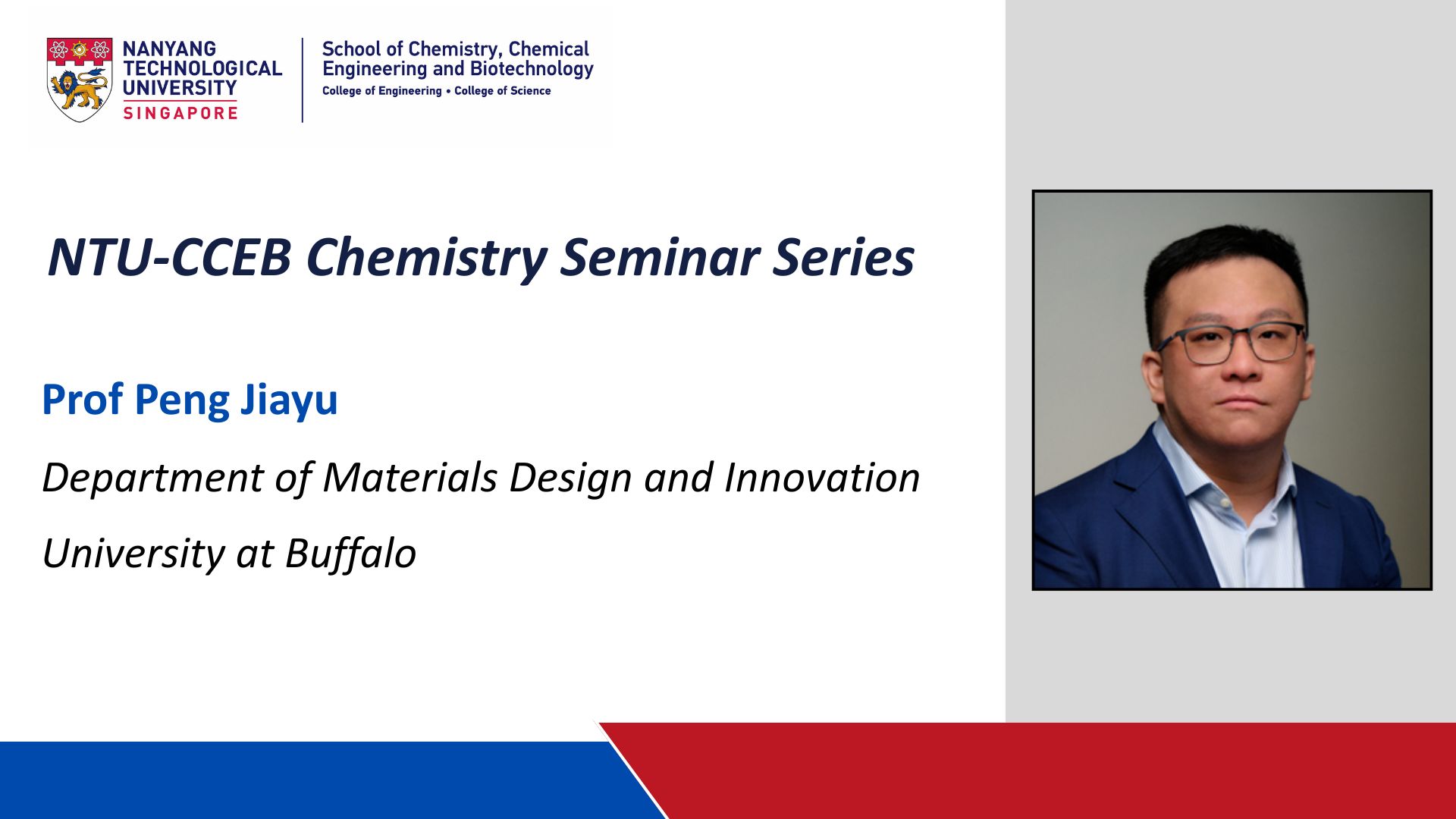
Jiayu Peng is an Assistant Professor in the Department of Materials Design and Innovation at the University at Buffalo. He obtained his Ph.D. in Materials Science and Engineering from the Massachusetts Institute of Technology (MIT) in 2022, after which he was a Postdoctoral Associate in the same department at MIT until 2024. His research group aims to combine data science and machine learning with materials physics and surface chemistry to unveil new physical principles and accelerate materials discovery for decarbonization and sustainability. He has been recognized with a Graduate Student Award from the Materials Research Society, the ENFL Future Investigator Spotlight from the Division of Energy and Fuels of the American Chemical Society, and the IUPAC-Zhejiang NHU International Award for Advancements in Green Chemistry for Young Chemists from the International Union of Pure and Applied Chemistry.